
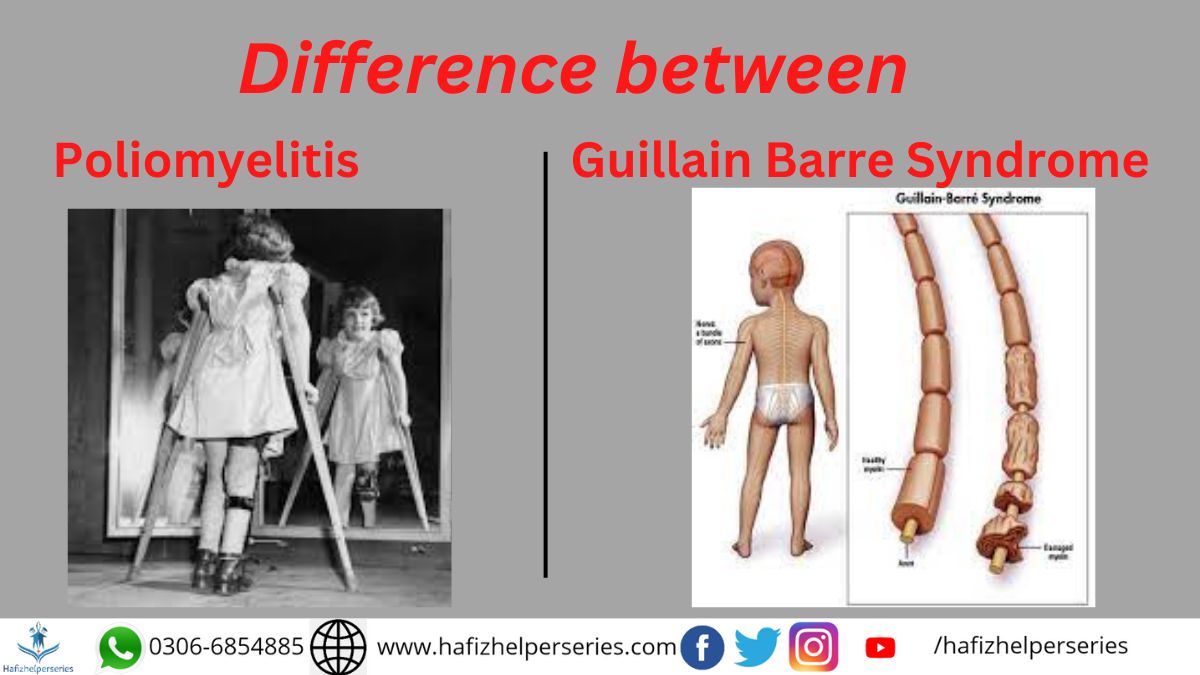
Difference Between Poliomyelitis & Guillain-Barre syndrome
Poliomyelitis
- Guillain-Barré Syndrome (GBS) and poliomyelitis (polio) are both neurological disorders that can cause muscle weakness and paralysis
- Onset and progression:polio often has a more sudden onset and can progress over the course of hours to several days.
- Distribution of weakness:polio often causes asymmetrical muscle weakness that is more pronounced in the legs
- Sensory symptoms:polio usually does not.
- Bulbar involvement:polio primarily affects the spinal cord and does not typically cause bulbar symptoms.
- Autonomic dysfunction:polio does not typically cause autonomic dysfunction.
- In POLIO, REFLEXES present, slowly progressive, asymmetrical permanent paralysis.
- Polio causes slowly progressive, asymmetrical permanent paralysis.
Guillain-Barre syndrome
- Guillain-Barré Syndrome (GBS) and poliomyelitis (polio) are both neurological disorders that can cause muscle weakness and paralysis
- Onset and progression: GBS typically develops over a period of days to a few weeks, with rapid progression of muscle weakness
- Distribution of weakness: GBS typically causes symmetrical muscle weakness, affecting both the upper and lower limbs
- Sensory symptoms: GBS can cause sensory symptoms such as tingling, numbness, or pain
- Bulbar involvement: GBS can also affect the muscles of the face, neck, and throat, causing bulbar symptoms such as difficulty speaking, swallowing, and breathing,
- Autonomic dysfunction: GBS can also cause autonomic dysfunction, resulting in symptoms such as changes in heart rate and blood pressure
- In GBS, REFLEXES absent, rapid ascending symmetrical paralysis.
- GBS causes rapidly progressive ascending symmetrical and reversible paralysis.
Poliomyelitis and Guillain-Barré Syndrome (GBS) are both neurological conditions affecting motor function but differ significantly in cause, pathology, and treatment. Here’s a detailed comparison:
1. Cause:
- Poliomyelitis:
Caused by the poliovirus, which primarily spreads through the fecal-oral route. It targets the anterior horn cells of the spinal cord, leading to motor neuron destruction. - Guillain-Barré Syndrome (GBS):
An autoimmune disorder often triggered by infections (e.g., Campylobacter jejuni, Epstein-Barr virus) or vaccinations. The immune system attacks peripheral nerves, leading to demyelination or axonal damage.
2. Pathophysiology:
- Poliomyelitis:
The virus invades and destroys motor neurons in the spinal cord and brainstem, resulting in muscle paralysis. The damage is permanent in severe cases. - GBS:
Involves an immune-mediated attack on the myelin sheath or axons of peripheral nerves. It often starts with inflammation and progresses to muscle weakness or paralysis. Unlike polio, the damage is typically reversible with treatment.
3. Onset:
- Poliomyelitis:
Gradual onset following a viral infection. Symptoms may start with fever, headache, and fatigue, progressing to paralysis over a few days. - GBS:
Sudden onset, often preceded by respiratory or gastrointestinal infection. Symptoms progress rapidly, peaking within days to weeks.
4. Symptoms:
- Poliomyelitis:
- Asymptomatic in most cases (90-95%).
- Paralytic polio causes asymmetric flaccid paralysis, usually affecting the lower limbs.
- Reflexes are diminished or absent, but sensation remains intact.
- GBS:
- Symmetrical ascending weakness (starts in the legs and progresses upward).
- Tingling or numbness in extremities.
- Reflexes are diminished or absent.
- May involve respiratory muscles, leading to respiratory failure in severe cases.
5. Diagnosis:
- Poliomyelitis:
Diagnosed via stool, throat swabs, or cerebrospinal fluid (CSF) testing for poliovirus RNA. - GBS:
Diagnosed through clinical symptoms, nerve conduction studies, and CSF analysis showing elevated protein levels with normal white cell count (albuminocytologic dissociation).
6. Treatment:
- Poliomyelitis:
No specific antiviral treatment. Management focuses on supportive care, including physical therapy to reduce contractures and improve mobility. Prevention via the polio vaccine is key. - GBS:
Treated with intravenous immunoglobulin (IVIG) or plasmapheresis to reduce immune-mediated damage. Supportive care includes ventilation in severe cases and physical rehabilitation for recovery.
7. Prognosis:
- Poliomyelitis:
Permanent paralysis in severe cases; recovery depends on the extent of neuron destruction. Post-polio syndrome may occur years later. - GBS:
Most patients recover fully within months to a year. Residual weakness may persist in some cases.
8. Prevention:
- Poliomyelitis:
Vaccination (oral or inactivated polio vaccine). - GBS:
No vaccine; prevention focuses on managing infections and reducing immune triggers.
Summary:
- Poliomyelitis is a viral disease with asymmetric, irreversible paralysis.
- GBS is an autoimmune disorder with symmetric, potentially reversible weakness.
Proper diagnosis and treatment are critical for both conditions to minimize complications.
(Visited 868 times, 1 visits today)


[…] READ MORE: Difference Between Poliomyelitis & Guillain-Barre syndrome […]